Format: E-Book
Read with: Kindle Oasis
Length: Novel
Genre: Historical Romance
POV: Third Person, Dual
Series: Standalone
Publisher: Warner Books
Hero: Sebastian Peyton
Heroine: Jewel Combs
Sensuality:🔥🔥🔥
Published On: Warner Books
Started On: October 06, 2026
Finished On: October 10, 2026
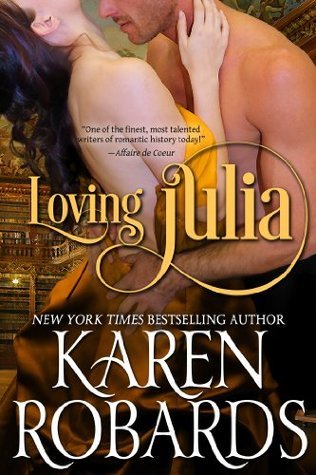
“He had made her a lady only to turn her into the one thing she had vowed she would never be: a whore.”
Revisiting Loving Julia by Karen Robards sixteen years after my first read turned out to be quite an interesting experience. When I first read this novel in 2010, I rated it three stars. This time around, I found myself enjoying it considerably more, even though certain aspects of the romance made me distinctly uncomfortable. Perhaps that is one of the more fascinating things about revisiting older romances. The stories remain the same, but we certainly do not. Our experiences, expectations, and perceptions change, sometimes making us more forgiving of certain things and far less tolerant of others. Loving Julia managed to provoke both reactions in me, and yet, by the time I turned the final page, I found myself surprisingly satisfied with how everything came together.
Sixteen-year-old Jewel Combs has known little beyond the harsh realities of London’s streets. With neither wealth nor respectable connections to protect her, she faces a future that promises very little in the way of happiness or security. An unexpected marriage to a dying gentleman changes her circumstances overnight, leaving her the widow of a man whose final act is intended to scandalize his aristocratic relations. Enter Sebastian Peyton, the thirty-one-year-old eighth Earl of Moorland, who has little patience for the audacious young woman claiming a place in his family’s affairs. But rather than dismiss Jewel outright, Sebastian decides to amuse himself by transforming this rough, outspoken street urchin into a respectable lady. Thus Jewel Combs becomes Julia Stratham, and what begins as an exercise in spite and amusement gradually turns into something neither of them is quite prepared for.
Sebastian is very much a hero fashioned in the tradition of older historical romances. Arrogant, commanding, emotionally distant, and accustomed to having his own way, he is hardly a man one would describe as particularly considerate. A widower with a young daughter, Sebastian carries scars from his previous marriage that has affected his relationship with his child and left him deeply disillusioned. His mother’s treatment of him does little to help matters. She regards him with such undisguised hostility that it is hardly surprising he has developed a rather indifferent attitude towards the feelings and opinions of others. I found his family circumstances particularly interesting because they explain much of his behaviour without necessarily excusing it. Beneath that cold exterior is a man who has been hurt in ways that continue to shape his relationships, and Jewel’s arrival upsets a household that has been suffocating under years of resentment and unresolved pain.
Jewel, on the other hand, is a heroine who very much acts her age. She is impulsive, stubborn, quick to take offence, and quite capable of being spiteful when things do not go her way. There were moments when I found her behaviour thoroughly exasperating, particularly when her reactions seemed driven more by wounded pride than common sense. But then, what else should one expect from a sixteen-year-old girl who has spent her entire life fighting for survival? She has never had the luxury of a secure childhood, much less the guidance that might have helped her navigate the unfamiliar world into which she is suddenly thrust. Her rough manners and sharp tongue conceal an innocence that has somehow survived the ugliness of her circumstances. And despite her tendency to lash out when hurt, there is something rather touching about the way she begins to yearn for Sebastian’s affection, even when he gives her precious little reason to believe that her feelings might ever be returned.
What troubled me most during this reread was a thirty-one-year-old man pursuing a sixteen-year-old girl, without even feeling a bit self-critical about the circumstances. Child marriages were once commonplace and still remain a reality in parts of the world today, but their prevalence does not make the imbalance any less disturbing. Marriage itself can be difficult enough for women who enter it in their twenties or thirties, particularly when most of the time, men fail to live up to what is expected of them in a relationship. The vulnerability of someone as young and inexperienced as Jewel makes that imbalance all the more pronounced. What made me particularly uncomfortable was Sebastian’s apparent lack of hesitation when his interest in her turned sexual. I have read older romances in which heroes grapple with their attraction to much younger heroines, feeling a measure of shame or unease over their desires. Sebastian, however, seems to experience none of that internal conflict. Once he decides he wants Jewel, he simply proceeds as though his desires are justification enough. There were moments when I could only shake my head at the man!
And that is where the romance becomes rather complicated. Sebastian initially regards Jewel as little more than an amusing inconvenience, someone he can use to provoke his mother and assert his authority within the household. His decision to mould her into a lady is hardly born of altruism, and the power he holds over her circumstances makes their relationship deeply unequal. When attraction enters the equation, his tendency to assume the worst of Jewel only makes matters more frustrating. Like so many emotionally scarred heroes of his generation, Sebastian is quick to mistake vulnerability for manipulation and desire for calculated seduction. I found myself wanting to give him a good shake on more than one occasion. Yet Robards also allows glimpses of the wounded man beneath his arrogance, particularly through his troubled relationship with his daughter. Those moments made it possible to understand how he had become so hardened, even when I wanted him to behave very differently.
For all my reservations, I cannot deny that Sebastian and Jewel have a certain combustible chemistry. Their interactions are rarely peaceful, and Jewel’s refusal to behave like the meek, grateful young woman Sebastian might have preferred makes for some entertaining confrontations. She challenges his authority, disrupts his carefully ordered existence, and refuses to remain conveniently within the boundaries he establishes for her. Sebastian, meanwhile, is a man so accustomed to emotional detachment that he seems almost bewildered by the intensity of his reactions to her. I enjoyed watching their relationship evolve beyond the roles they initially assigned each other, even though the journey was frequently messy and neither character was particularly blameless. Jewel’s youthful volatility and Sebastian’s arrogance make for a difficult combination, but they also give the romance much of its fire.
Another aspect that worked particularly well for me was the mystery woven into the storyline. It adds an unexpected layer of intrigue to what might otherwise have been a fairly conventional tale of a street urchin transformed into a lady. As the story progresses, the atmosphere becomes increasingly charged with uncertainty, and I found myself becoming more invested in the circumstances surrounding Sebastian’s family and the secrets that continue to cast their shadows over his household. The mystery provides a welcome diversion from the more frustrating aspects of the romance while giving the characters additional challenges to navigate. I particularly appreciated how it brought a sense of urgency to the latter part of the novel, making the story more compelling than I had initially anticipated.
What surprised me most was how much better the novel worked for me this time around. My discomfort with the age difference never entirely disappeared, nor did my frustration with Sebastian’s behaviour or Jewel’s occasional bouts of childish spite. But somewhere along the way, I became invested in these two deeply imperfect characters and the possibility that they might find something worthwhile together. Robards has a knack for writing passionate, turbulent romances populated by characters who are not always easy to like, and Loving Julia is certainly no exception. It is a product of an era when historical romance heroes were frequently allowed to be far more domineering, and heroines considerably younger and more vulnerable, than many readers would find acceptable today. That does not mean the story is without merit, but it does mean that enjoying it requires acknowledging those uncomfortable elements rather than pretending they do not exist.
Ultimately, Loving Julia was a reread that left me with mixed feelings but a greater appreciation for the story as a whole. The mystery gave the novel an added flair, the romance was suitably passionate, and the conclusion brought everything together in a way that satisfied me despite my earlier misgivings. I would not call Sebastian an ideal romantic hero, and Jewel certainly tested my patience, but somehow these two managed to win me over. Sixteen years after my first encounter with them, I found enough to appreciate that my original three-star rating has moved up to four stars. Not a flawless romance by any means, but one that reminded me why Karen Robards was such a compelling voice in historical romance.
Recommended for: Readers who enjoy old-school historical romances, domineering and emotionally scarred heroes, spirited heroines, turbulent relationships, and a touch of mystery.
Final Verdict: A rough diamond, a hardened heart, and a love as turbulent as it is passionate. Loving Julia was a complicated romance that won me over despite its flaws.
Purchase Links: Amazon | Apple


